Single-cell multi-omic and spatial profiling of human kidneys implicates the fibrotic microenvironment in kidney disease progression
Authors: Abedini A , Levinsohn J , Klötzer KA , Dumoulin B , Ma Z , Frederick J , Dhillon P , Balzer MS , Shrestha R , Liu H , Vitale S , Bergeson AM , Devalaraja-Narashimha K , Grandi P , Bhattacharyya T , Hu E , Pullen SS , Boustany-Kari CM , Guarnieri P , Karihaloo A , Traum D , Yan H , Coleman K , Palmer M , Sarov-Blat L , Morton L , Hunter CA , Kaestner KH , Li M , Susztak K
Journal: Nature genetics
Published: 2024 Aug
Volume: 56
(8)
Pages: 1712-1724
Cite this article
Abedini A, Levinsohn J, Klötzer KA, Dumoulin B, Ma Z, Frederick J, Dhillon P, Balzer MS, Shrestha R, Liu H, Vitale S, Bergeson AM, Devalaraja-Narashimha K, Grandi P, Bhattacharyya T, Hu E, Pullen SS, Boustany-Kari CM, Guarnieri P, Karihaloo A, Traum D, Yan H, Coleman K, Palmer M, Sarov-Blat L, Morton L, Hunter CA, Kaestner KH, Li M, Susztak K.Single-cell multi-omic and spatial profiling of human kidneys implicates the fibrotic microenvironment in kidney disease progression. Nature genetics. 2024 Aug. 56(8):1712-1724. doi:10.1038/s41588-024-01802-x. PMID:39048792.
Abstract
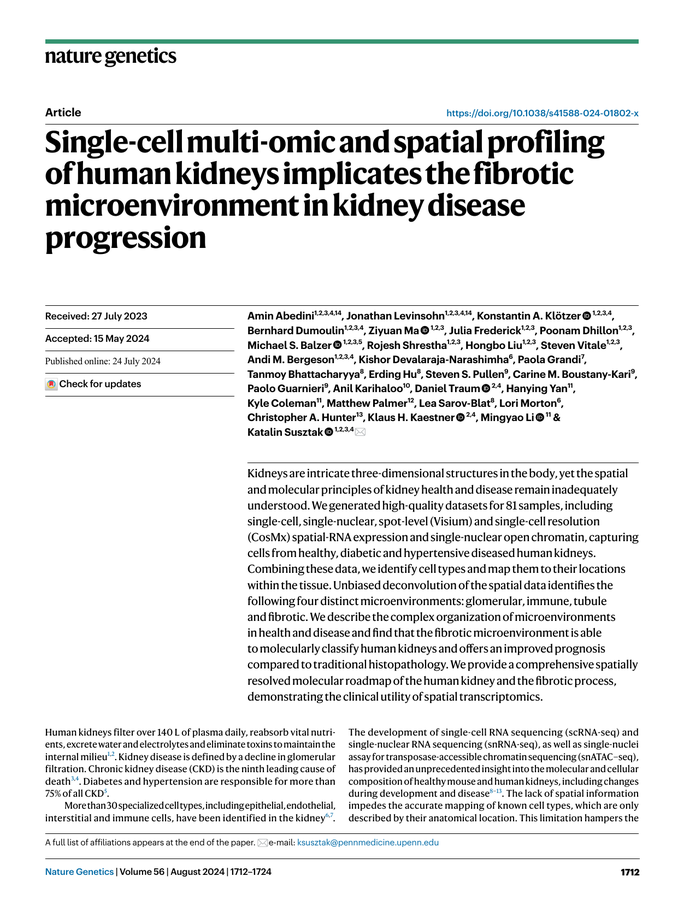
Kidneys are intricate three-dimensional structures in the body, yet the spatial and molecular principles of kidney health and disease remain inadequately understood. We generated high-quality datasets for 81 samples, including single-cell, single-nuclear, spot-level (Visium) and single-cell resolution (CosMx) spatial-RNA expression and single-nuclear open chromatin, capturing cells from healthy, diabetic and hypertensive diseased human kidneys. Combining these data, we identify cell types and map them to their locations within the tissue. Unbiased deconvolution of the spatial data identifies the following four distinct microenvironments: glomerular, immune, tubule and fibrotic. We describe the complex organization of microenvironments in health and disease and find that the fibrotic microenvironment is able to molecularly classify human kidneys and offers an improved prognosis compared to traditional histopathology. We provide a comprehensive spatially resolved molecular roadmap of the human kidney and the fibrotic process, demonstrating the clinical utility of spatial transcriptomics.