News

BALZER LAB is hiring a postdoc

Open Postdoc Position – Single-cell & Spatial Omics in Kidney Adaptation (ERC-funded)

20 Apr 2026

Employer
Department of Nephrology and Hypertension, University Hospital Schleswig-Holstein (UKSH), and Kiel University (CAU)

Location
Kiel, Germany

Salary
TV-L E13 (100%); ~57,000–81,000 EUR/year + full social security coverage (healthcare, pension, paid leave)

Contract duration
2 years (with possible extension)

Closing date
June 1, 2026

We are seeking a postdoctoral researcher to join the ERC Starting Grant project SINGuLAR (https://cordis.europa.eu/project/id/101219388) at the Balzer Lab (https://balzer-lab.org), investigating how human kidneys adapt to organ loss.

Our lab studies how human kidneys regenerate after organ loss using cutting-edge single-cell and translational approaches. Rather than focusing on injury, this project investigates pure adaptation in living kidney donors—a unique human model in which individuals lose 50% of kidney mass yet show remarkable compensatory growth.

You will contribute to building the first longitudinal single-cell and spatial atlas of human kidney adaptation, combining single-cell RNA-seq, spatial transcriptomics, and single-cell ATAC-seq with deeply phenotyped clinical cohorts. In this role, you will help establish and drive the experimental and computational framework of the project, including developing single-cell and spatial omics pipelines, generating and integrating multi-omic datasets, and collaborating closely with clinicians and interdisciplinary partners.

Requirements

We are looking for candidates with a strong background in single-cell and/or spatial omics and experience in bioinformatics analysis and data integration.

  • PhD in bioinformatics, computational biology, genomics, molecular biology, or a related field
  • Proven experience with single-cell data analysis (e.g., scRNA-seq; spatial or epigenomics is a strong plus)
  • Programming skills in R and/or Python
  • Interest in or willingness to engage in wet-lab work (single-cell workflows)
  • Ability to work independently in an interdisciplinary environment
  • Excellent English communication skills

What We Offer

  • A full-time postdoctoral position (TV-L E13, ~57,000–81,000 EUR/year depending on experience) for 2 years, with the option of renewal within an ERC Starting Grant-funded position
  • Extensive social benefits (health insurance, pension scheme, paid leave, and strong employee protections typical of the German public sector)
  • A high-risk/high-reward project addressing a fundamental question in human biology
  • Access to state-of-the-art single-cell and spatial omics technologies
  • A collaborative and interdisciplinary research environment bridging clinic and computation
  • Strong support for career development, publications, and international visibility

Environment

You will work at the interface of Kiel University (CAU) and the University Hospital Schleswig-Holstein (UKSH), one of Germany’s leading academic medical centers. The research environment includes close collaboration with the Institute of Clinical Molecular Biology (IKMB) and the Competence Centre for Genomic Analysis (CCGA), providing access to cutting-edge genomics infrastructure and expertise. Kiel hosts multiple Excellence Clusters (including Precision Medicine in Chronic Inflammation) and Collaborative Research Centers (SFBs), offering a highly interactive ecosystem connecting basic science, computation, and clinical research.

You love science and the outdoors? This place is for you! Kiel is a vibrant coastal city on the Baltic Sea, known as one of Germany’s premier sailing hubs, with immediate access to sailing, kayaking, swimming, and waterfront living. The surrounding region offers extensive cycling routes, running trails, and green spaces. With a welcoming international community, short commutes, and a high quality of life, Kiel combines a dynamic academic environment with a relaxed, nature-oriented lifestyle.

Application

If you are passionate about understanding and ultimately harnessing the mechanisms of human kidney adaptation, we would love to hear from you.

Please send your CV, letter of motivation, and contact details of two references to Prof. Michael S. Balzer (MichaelSoeren.Balzer@uksh.de).

BALZER LAB is hiring a PhD student

Open PhD Student Position – Single-cell & Spatial Omics in Kidney Adaptation (ERC-funded)

20 Apr 2026

Employer
Department of Nephrology and Hypertension, University Hospital Schleswig-Holstein (UKSH), and Kiel University (CAU)

Location
Kiel, Germany

Salary
TV-L E13 (65%); ~37,000/year + full social security coverage (healthcare, pension, paid leave)

Contract duration
3 years

Closing date
June 1, 2026

We are seeking a PhD student to join the ERC Starting Grant project SINGuLAR (https://cordis.europa.eu/project/id/101219388) at the Balzer Lab (https://balzer-lab.org), investigating how human kidneys adapt to organ loss.

Our lab studies how human kidneys regenerate after organ loss using cutting-edge single-cell and translational approaches. Rather than focusing on injury, this project investigates pure adaptation in living kidney donors—a unique human model in which individuals lose 50% of kidney mass yet show remarkable compensatory growth.

You will contribute to building the first longitudinal single-cell and spatial atlas of human kidney adaptation, combining single-cell RNA-seq, spatial transcriptomics, and single-cell ATAC-seq with deeply phenotyped clinical cohorts. In this role, you will support the development and application of experimental and computational workflows, working closely with a postdoctoral researcher and other team members. You will be involved in generating and analyzing multi-omic datasets and contributing to collaborative projects with clinicians and interdisciplinary partners, with increasing independence over the course of your PhD.

Requirements

We are looking for candidates with a strong interest in single-cell and/or spatial omics and a willingness to develop skills in bioinformatics analysis and data integration.

  • Master’s degree (or equivalent) in bioinformatics, computational biology, genomics, molecular biology, or a related field
  • Basic experience or strong interest in single-cell data analysis (e.g., scRNA-seq; spatial or epigenomics is a strong plus)
  • Programming skills in R and/or Python
  • Interest in or willingness to engage in wet-lab work (single-cell workflows)
  • Ability to work collaboratively in an interdisciplinary environment, with growing independence over time
  • Excellent English communication skills

What We Offer

  • A **3-year PhD position (TV-L E13, 65%, ~37,000 EUR/year) within an ERC Starting Grant-funded position
  • Extensive social benefits (health insurance, pension scheme, paid leave, and strong employee protections typical of the German public sector)
  • A high-risk/high-reward project addressing a fundamental question in human biology
  • Access to state-of-the-art single-cell and spatial omics technologies
  • A collaborative and interdisciplinary research environment bridging clinic and computation
  • Structured supervision and training, with strong support for skill development, publications, and career progression

Environment

You will work at the interface of Kiel University (CAU) and the University Hospital Schleswig-Holstein (UKSH), one of Germany’s leading academic medical centers. The research environment includes close collaboration with the Institute of Clinical Molecular Biology (IKMB) and the Competence Centre for Genomic Analysis (CCGA), providing access to cutting-edge genomics infrastructure and expertise. Kiel hosts multiple Excellence Clusters (including Precision Medicine in Chronic Inflammation) and Collaborative Research Centers (SFBs), offering a highly interactive ecosystem connecting basic science, computation, and clinical research.

You love science and the outdoors? This place is for you! Kiel is a vibrant coastal city on the Baltic Sea, known as one of Germany’s premier sailing hubs, with immediate access to sailing, kayaking, swimming, and waterfront living. The surrounding region offers extensive cycling routes, running trails, and green spaces. With a welcoming international community, short commutes, and a high quality of life, Kiel combines a dynamic academic environment with a relaxed, nature-oriented lifestyle.

Application

If you are passionate about understanding and ultimately harnessing the mechanisms of human kidney adaptation, we would love to hear from you.

Please send your CV, letter of motivation, and contact details of two references to Prof. Michael S. Balzer (MichaelSoeren.Balzer@uksh.de).

BALZER LAB is hiring a PhD student

Open PhD Student Position – Organoid & Tubuloid Models in Kidney Adaptation (ERC-funded)

20 Apr 2026

Employer
Department of Nephrology and Hypertension, University Hospital Schleswig-Holstein (UKSH), and Kiel University (CAU)

Location
Kiel, Germany

Salary
TV-L E13 (65%); ~37,000/year + full social security coverage (healthcare, pension, paid leave)

Contract duration
3 years

Closing date
June 1, 2026

We are seeking a PhD student to join the ERC Starting Grant project SINGuLAR (https://cordis.europa.eu/project/id/101219388) at the Balzer Lab (https://balzer-lab.org), investigating how human kidneys adapt to organ loss.

Our lab studies how human kidneys regenerate after organ loss using cutting-edge single-cell and translational approaches. Rather than focusing on injury, this project investigates pure adaptation in living kidney donors—a unique human model in which individuals lose 50% of kidney mass yet show remarkable compensatory growth.

You will contribute to building the first longitudinal single-cell and spatial atlas of human kidney adaptation, while establishing complementary patient-derived organoid and tubuloid models. In this role, you will focus on developing and applying experimental systems to functionally interrogate adaptation mechanisms identified through multi-omic analyses. Specifically, you will establish tubuloid cultures from patient samples, systematically expand and biobank these models, and perform molecular and functional characterization. You will work closely with other team members generating single-cell and spatial datasets, enabling the integration of in vitro models with human in vivo data. Over the course of your PhD, you will initiate mechanistic and validation studies, with increasing independence.

Requirements

We are looking for candidates with a strong interest in organoid/tubuloid systems, kidney biology, and/or single-cell biology, and a willingness to develop skills in bioinformatics analysis and data integration.

  • Master’s degree (or equivalent) in molecular biology, cell biology, bioengineering, bioinformatics, or a related field
  • Experience with cell culture, organoids, or primary cell systems is highly desirable
  • Experience or interest in functional and mechanistic studies in human-derived model systems
  • Basic programming skills in R and/or Python (or willingness to learn)
  • Interest in or willingness to engage in computational analysis (single-cell workflows)
  • Ability to work collaboratively in an interdisciplinary environment, with growing independence over time
  • Excellent English communication skills

What We Offer

  • A **3-year PhD position (TV-L E13, 65%, ~37,000 EUR/year) within an ERC Starting Grant-funded position
  • Extensive social benefits (health insurance, pension scheme, paid leave, and strong employee protections typical of the German public sector)
  • A high-risk/high-reward project addressing a fundamental question in human biology
  • Access to state-of-the-art single-cell and spatial omics technologies
  • A collaborative and interdisciplinary research environment bridging clinic and computation
  • Structured supervision and training, with strong support for skill development, publications, and career progression

Environment

You will work at the interface of Kiel University (CAU) and the University Hospital Schleswig-Holstein (UKSH), one of Germany’s leading academic medical centers. The research environment includes close collaboration with the Institute of Clinical Molecular Biology (IKMB) and the Competence Centre for Genomic Analysis (CCGA), providing access to cutting-edge genomics infrastructure and expertise. Kiel hosts multiple Excellence Clusters (including Precision Medicine in Chronic Inflammation) and Collaborative Research Centers (SFBs), offering a highly interactive ecosystem connecting basic science, computation, and clinical research.

You love science and the outdoors? This place is for you! Kiel is a vibrant coastal city on the Baltic Sea, known as one of Germany’s premier sailing hubs, with immediate access to sailing, kayaking, swimming, and waterfront living. The surrounding region offers extensive cycling routes, running trails, and green spaces. With a welcoming international community, short commutes, and a high quality of life, Kiel combines a dynamic academic environment with a relaxed, nature-oriented lifestyle.

Application

If you are passionate about understanding and ultimately harnessing the mechanisms of human kidney adaptation, we would love to hear from you.

Please send your CV, letter of motivation, and contact details of two references to Prof. Michael S. Balzer (MichaelSoeren.Balzer@uksh.de).

BALZER LAB is hiring

We are hiring

13 Apr 2026

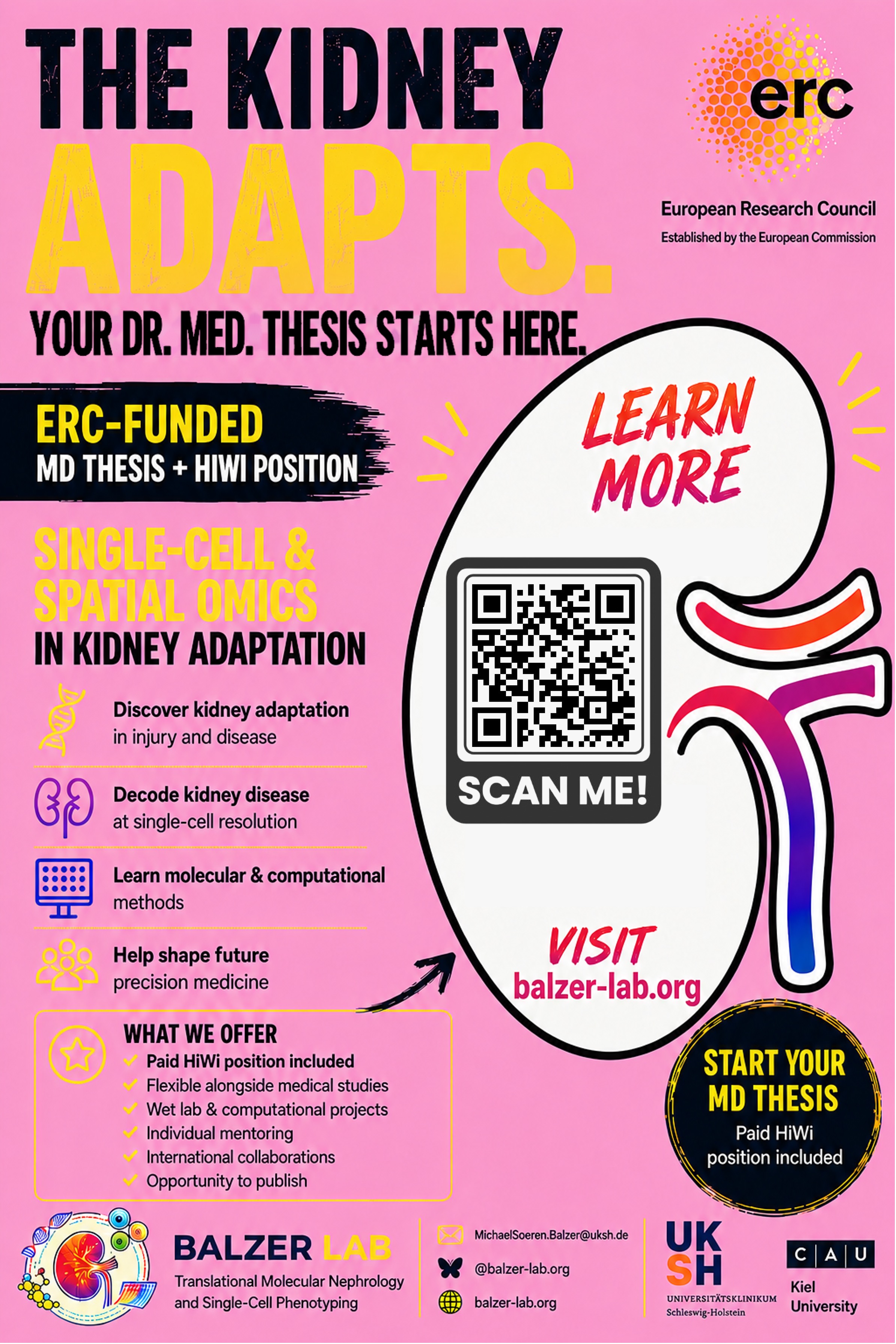
We are hiring motivated people to join the BALZER LAB. We are currently looking for:

We are particularly interested in candidates with backgrounds in:

  • Single-cell or spatial omics
  • Computational biology or data science
  • Molecular biology
  • Translational nephrology

If you are interested please contact us and send your CV and a letter of intent to Professor Balzer.

BALZER LAB relocates to Kiel

The BALZER LAB moves from Charité to Kiel

03 Apr 2026

As of early 2026, the BALZER LAB will move from Charité – Universitätsmedizin Berlin to Kiel University and the University Hospital Schleswig-Holstein.

In Kiel, the lab will be part of the Department of Nephrology and Hypertension, focusing on translational molecular nephrology and single-cell phenotyping in research and teaching. The professorship is integrated into the faculty’s research priority “Precision Medicine – Research, Healing, Understanding”," with links to the Excellence Cluster “Precision Medicine in Chronic Inflammation” (PMI) and the “Precision Health in Schleswig-Holstein” (PHSH) initiative. The research program will use omics and single-cell approaches to collaborate with the Competence Centre for Genomic Analysis (CCGA) and strengthen nephrology research within the Kiel medical faculty.

This move enables integration of clinical nephrology, experimental research, and translational studies.

We are currently recruiting at multiple levels (e.g., PhD students, postdocs, and technical staff). Further details will be available soon (URL to follow).