Treatment effects of soluble guanylate cyclase modulation on diabetic kidney disease at single-cell resolution
Authors: Balzer MS , Pavkovic M , Frederick J , Abedini A , Freyberger A , Vienenkötter J , Mathar I , Siudak K , Eitner F , Sandner P , Grundmann M , Susztak K
Journal: Cell reports. Medicine
Published: 2023 Apr 18
Volume: 4
(4)
Pages: 100992
Cite this article
Balzer MS, Pavkovic M, Frederick J, Abedini A, Freyberger A, Vienenkötter J, Mathar I, Siudak K, Eitner F, Sandner P, Grundmann M, Susztak K.Treatment effects of soluble guanylate cyclase modulation on diabetic kidney disease at single-cell resolution. Cell reports. Medicine. 2023 Apr 18. 4(4):100992. doi:10.1016/j.xcrm.2023.100992. PMID:37023747.
Abstract
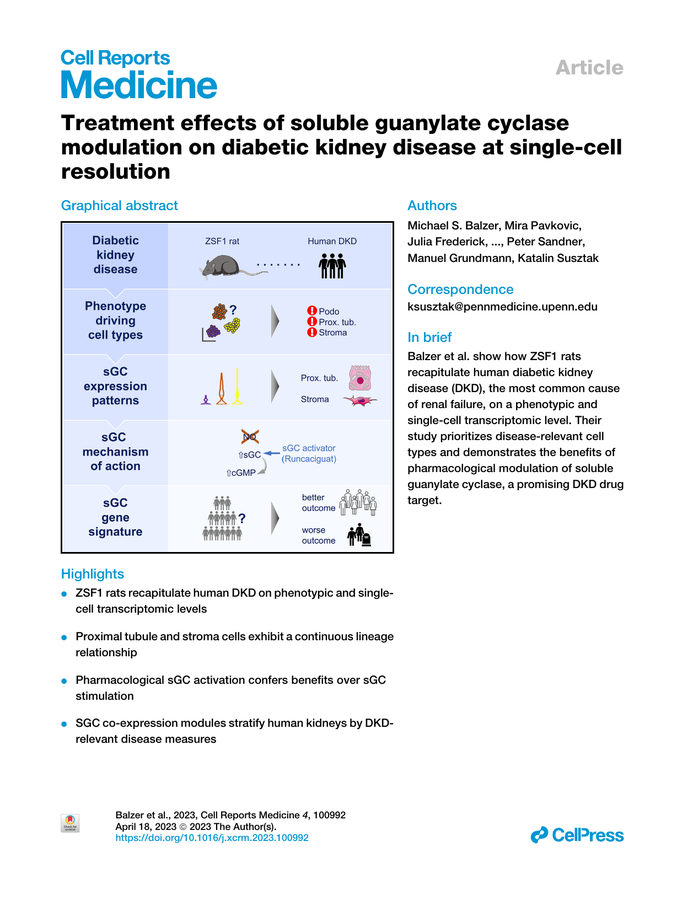
Diabetic kidney disease (DKD) is the most common cause of renal failure. Therapeutics development is hampered by our incomplete understanding of animal models on a cellular level. We show that ZSF1 rats recapitulate human DKD on a phenotypic and transcriptomic level. Tensor decomposition prioritizes proximal tubule (PT) and stroma as phenotype-relevant cell types exhibiting a continuous lineage relationship. As DKD features endothelial dysfunction, oxidative stress, and nitric oxide depletion, soluble guanylate cyclase (sGC) is a promising DKD drug target. sGC expression is specifically enriched in PT and stroma. In ZSF1 rats, pharmacological sGC activation confers considerable benefits over stimulation and is mechanistically related to improved oxidative stress regulation, resulting in enhanced downstream cGMP effects. Finally, we define sGC gene co-expression modules, which allow stratification of human kidney samples by DKD prevalence and disease-relevant measures such as kidney function, proteinuria, and fibrosis, underscoring the relevance of the sGC pathway to patients.