The Nuclear Receptor ESRRA Protects from Kidney Disease by Coupling Metabolism and Differentiation
Authors: Dhillon P , Park J , Hurtado Del Pozo C , Li L , Doke T , Huang S , Zhao J , Kang HM , Shrestra R , Balzer MS , Chatterjee S , Prado P , Han SY , Liu H , Sheng X , Dierickx P , Batmanov K , Romero JP , Prósper F , Li M , Pei L , Kim J , Montserrat N , Susztak K
Journal: Cell metabolism
Published: 2021 Feb 2
Volume: 33
(2)
Pages: 379-394.e8
Cite this article
Dhillon P, Park J, Hurtado Del Pozo C, Li L, Doke T, Huang S, Zhao J, Kang HM, Shrestra R, Balzer MS, Chatterjee S, Prado P, Han SY, Liu H, Sheng X, Dierickx P, Batmanov K, Romero JP, Prósper F, Li M, Pei L, Kim J, Montserrat N, Susztak K.The Nuclear Receptor ESRRA Protects from Kidney Disease by Coupling Metabolism and Differentiation. Cell metabolism. 2021 Feb 2. 33(2):379-394.e8. doi:10.1016/j.cmet.2020.11.011. PMID:33301705.
Abstract
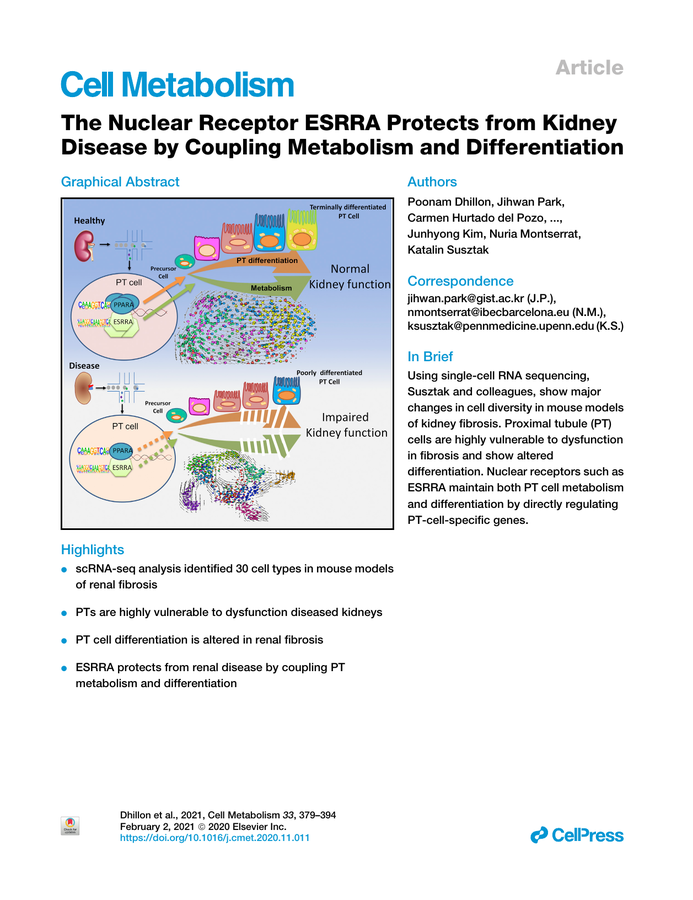
Kidney disease is poorly understood because of the organ's cellular diversity. We used single-cell RNA sequencing not only in resolving differences in injured kidney tissue cellular composition but also in cell-type-specific gene expression in mouse models of kidney disease. This analysis highlighted major changes in cellular diversity in kidney disease, which markedly impacted whole-kidney transcriptomics outputs. Cell-type-specific differential expression analysis identified proximal tubule (PT) cells as the key vulnerable cell type. Through unbiased cell trajectory analyses, we show that PT cell differentiation is altered in kidney disease. Metabolism (fatty acid oxidation and oxidative phosphorylation) in PT cells showed the strongest and most reproducible association with PT cell differentiation and disease. Coupling of cell differentiation and the metabolism was established by nuclear receptors (estrogen-related receptor alpha [ESRRA] and peroxisomal proliferation-activated receptor alpha [PPARA]) that directly control metabolic and PT-cell-specific gene expression in mice and patient samples while protecting from kidney disease in the mouse model.